Maintaining stable temperatures is essential for reef aquariums, where corals and beneficial livestock depend on precise thermal conditions. This guide highlights top-rated submersible heaters that balance reliability, safety features, and ease of use. Each product below includes practical protections against overheating, leaving-water conditions, and accurate temperature control to support vibrant marine life.
Summary Of Chosen Products
| Product | Brand | Wattage | Tank Range (Gallons) |
|---|---|---|---|
| hygger Aquarium Heater | hygger | 300W | 40–80 |
| Orlushy Submersible Aquarium Heater | Orlushy | 300W | 40–55 |
| HiTauing Aquarium Heater | HiTauing | 300W | 40–75 |
| Orlushy Submersible Aquarium Heater | Orlushy | 500W | 40–75 |
| FREESEA Aquarium Heater | FREESEA | 100W | 20–40 |
hygger Aquarium Heater 300W

The hygger 300W heater is designed for 40 to 80 gallon tanks in freshwater or saltwater setups. It features an intelligent overheating and out-of-water protection system that automatically cuts power if water levels drop or temperatures rise above 94°F. The digital LED controller provides a 59℉–93℉ range with ±1°F accuracy, and its edge-mounted display lets you adjust temperature without reaching into the water. A clear alert system signals high or low temps, helping prevent “boiled fish.” The heater is 10.8 inches long and comes with a long 10.1-foot power cord for flexible placement.
Key features:
– Overheating and out-of-water protection with audible alarm
– Digital LED temperature display and adjustable range
– Easy mounting with included bracket
– Suitable for both freshwater and saltwater aquariums
Orlushy Submersible Aquarium Heater, 300W
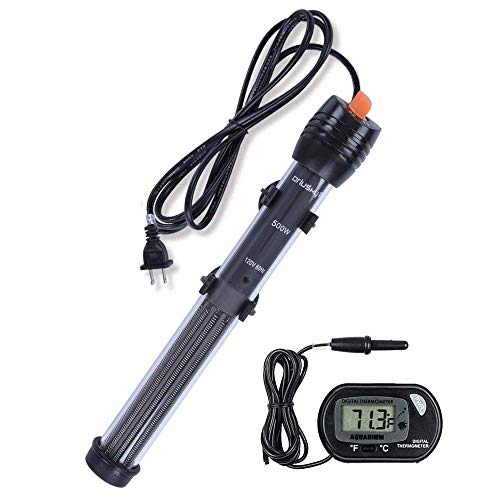
This 300W heater is suitable for 40–55 gallon tanks and includes a 2-suction-cup mounting system with a free thermometer. It features an adjustable temperature area for fine-tuning, with a simple knob-style control. The unit uses 2mm thickened quartz glass for enhanced durability and is designed for both freshwater and saltwater environments. It is compact and easy to conceal inside the tank while maintaining reliable heating performance.
Key features:
– Adjustable temperature control
– Explosion-proof quartz glass
– Suitable for marine and freshwater tanks
– Easy masking inside the aquarium
HiTauing Aquarium Heater, 300W
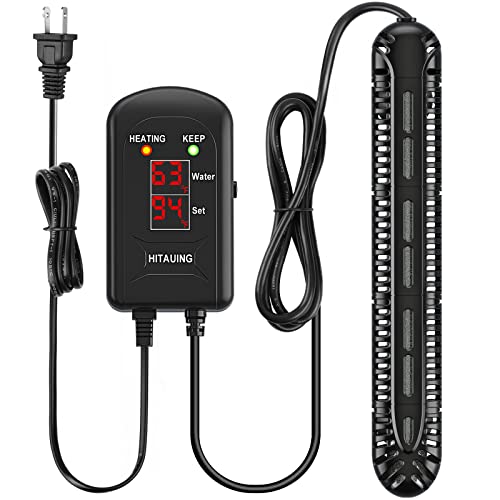
The HiTauing 300W heater targets 40–75 gallon tanks and includes a robust safety profile: explosion-proof quartz glass, an ABS protective shell, and nickel-chromium heating wire for fast, stable heating. A dual-protection mechanism shuts off heating if the water level falls below the required level or the temperature exceeds the set point. The controller supports an 63–94℉ range (17–34℃) and a long 8.2-foot cord for flexible setup.
Key features:
– Explosion-proof quartz glass
– Over-temperature and out-of-water protection
– Extended power cord for flexible placement
– Clear digital readout for set and current temperatures
Orlushy Submersible Aquarium Heater, 500W
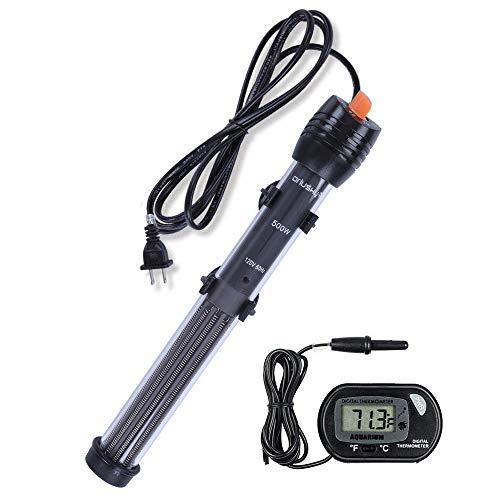
This 500W heater is built for 40–75 gallon tanks and comes with a 6-foot power cord. It uses a robust adjustable thermostat to maintain a consistent water temperature and features 2mm thick quartz glass for durability. The unit is suitable for both freshwater and saltwater fish tanks and integrates seamlessly into most aquariums with its easy-to-hide form factor.
Key features:
– Adjustable thermostat
– Suitable for larger tanks (40–75 gallons)
– Explosion-proof quartz glass
– Suitable for mixed aquatic environments
FREESEA Aquarium Heater, 100W

The FREESEA 100W heater targets smaller reef or nano setups (20–40 gallons) with a compact 8.3-inch body. It provides overheating and off-water protection and uses a digital LED controller with a 64℉–95℉ range and ±1°F accuracy. It displays current and preset temperatures on the LED screen and has a 6.6-foot power cord for flexible placement, making it suitable for smaller reef systems or quarantine tanks.
Key features:
– Suitable for smaller tanks
– Digital LED temperature display
– Overheating and off-water protection
– Long power cord for flexible placement
Buying Guide: Reef Tank Heater Considerations
- Tank size and heater wattage: Larger tanks require higher wattage to reach and sustain temperature. Match the heater to the tank’s gallon capacity using manufacturer guidelines.
- Protection features: Look for automatic shut-off when water is low or when overheating is detected. Out-of-water sensors prevent hazardous heating when surface is exposed.
- Temperature range and accuracy: Reef tanks benefit from narrow, stable ranges; seek models offering ±1°F accuracy and a wide controllable range.
- Sensor placement and control: External digital controllers reduce the need for sensor placement inside water, minimizing disturbance and risk of spillage.
- Durability and safety: Quartz glass heating elements and shrouded ABS housings improve safety and longevity in marine environments.
- Installation practicality: Suction-cup mounting, edge brackets, and long power cords enhance placement flexibility behind rockwork or filtration systems.
- Maintenance: Choose heaters with clear indicator lights or error codes to simplify troubleshooting and ensure reliable ongoing performance.
- Energy considerations: Efficient heaters with rapid warm-up reduce energy use while maintaining stable temperatures, which is particularly important in reef setups with heat-sensitive corals.
- Compatibility: Ensure the heater supports saltwater and freshwater use if you operate mixed systems or plan to migrate tanks in the future.
Overall, select a heater that offers robust safety protections, precise temperature control, and a form factor that fits your reef tank’s layout. The products listed above provide a range of wattages and protective features suitable for many standard reef configurations, helping maintain a stable environment for coral growth and marine life.