South American and African desert tortoises, like the sulcata, benefit from reliable heating and UVB lighting that mimics natural sun exposure. This guide highlights top-rated lights and heaters designed to promote healthy shell growth, digestion, and activity. Below, five carefully chosen products cover dual-head heat lamps, UVB bulbs, affordable fixtures, and programmable options suitable for sulcata habitats, terrariums, and outdoor shelters.
The following quick reference compares five standout items to help you decide quickly. For convenience, a summary table is included in this intro and expanded in detail within each product section.
| Product | Brand | Key Benefit |
|---|---|---|
| Petboda Reptile Heat Lamp, Dual Head | Petboda | Double heads for larger basking area, adjustable timer, dimmable heat |
| LUCKY HERP UVA UVB Reptile Light 10.0 | LUCKY HERP | Long-lasting UVB with high CRI, balanced UVA/UVB spectrum |
| DXOPHIEX 15 inch Dual Reptile Light Fixture | DXOPHIEX | Two independent lamps, built-in UVB and ceramic heat options |
| Pawfly Reptile Heat Lamp | Pawfly | Versatile 50 W with timer and dimming, 360° adjustable head |
| DOMICA Dimmable Reptile Heat Lamp | DOMICA | 360° rotatable clip, safety design, high heat distribution |
Petboda Reptile Heat Lamp With Cycle Timer

The Petboda double-headed heat lamp expands the basking area, which is useful for sulcata tortoises that require ample space to thermoregulate. It offers three brightness (heat) settings via a simple +/- control, enabling you to adjust warmth as your tortoise grows or seasonal needs change. The upgraded cycle timer allows continuous or timed operation, turning on and off at the same time every day. A crystal oscillator helps prevent timer failures common in lower-quality models. The 15.2-inch goosenecks rotate 360 degrees, and a strong clamp with a sponge pad supports stable mounting in tanks, terrariums, or outdoor enclosures.
LUCKY HERP UVA UVB Reptile Light 10.0, 23W

This 23W UVB bulb delivers 10.0 UVB output with UVA support, designed to reduce UVB degradation over time. The bulb projects a sun-like spectrum with a high color rendering index (around 90%), helping maintain natural reptile colors and supporting calcium metabolism and bone health. The design emphasizes longer UVB life—up to about a year—minimizing frequent replacements while maintaining consistent coverage for desert-dwelling species such as sulcatas.
DXOPHIEX 15 Inch Dual Reptile Light Fixture

The DXOPHIEX fixture supports dual lamps with up to 150W per socket, enabling a robust heat and UVB setup for large enclosures. Included are two bulbs: a 100W UVA/UVB lamp and a ceramic heat emitter. The UVA/UVB component simulates natural sunlight, promoting skin and bone health, while the ceramic heat lamp provides radiant warmth without extra light that could disturb sleep. Two independent switches allow precise control for day-night cycles and selective lighting in different habitat zones.
Pawfly Reptile Heat Lamp With 50 W Bulb

The Pawfly setup focuses on versatility with a 50W E26 bulb, delivering strong, stable heat and roughly 97% UVA to mimic sunlight. It includes a timer and dimming options (2/4/8 hours and four heating/brightness levels), enabling you to tailor a basking zone that encourages natural behaviors. The flexible head rotates 360°, and the adjustable distance helps prevent overheating while maintaining a comfortable warmth for sulcata tortoises.
DOMICA Dimmable Reptile Heat Lamp With Timer
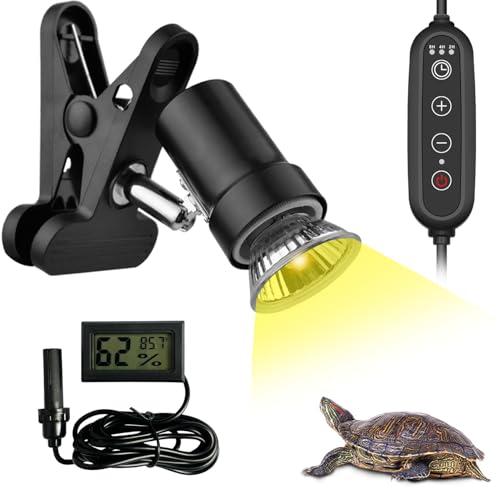
The DOMICA lamp offers a durable, safety-minded design with heat-resistant aluminum alloy coating and a reinforced ceramic base. It includes a 360° rotatable clip for precise heat placement and distributes warmth evenly to support shell growth and digestion. The product emphasizes multiple safety tips, such as mounting height and careful interval cooling, to reduce the risk of overheating or electrical issues in humid terrarium conditions.
Buying Guide: Key Considerations For Sulcata Tortoise Lighting
- Heat vs. UVB balance: Sulcata tortoises rely on both radiant heat and UVB exposure for metabolism and shell health. Choose fixtures that combine heat lamps with UVB/ UVA bulbs or use separate units placed at appropriate distances to create a basking zone and a UV exposure area.
- Distance and coverage: Large tortoises need wide basking areas. Look for adjustable goosenecks, wide-angle fixtures, or multiple lamps to cover a broad space. Ensure the lamp distance aligns with the bulb’s wattage to avoid overheating.
- Durability and safety: Reptile habitats can be humid or dusty. Select lamps with heat-resistant housings, sturdy clamps, and safe mounting options. Check warnings about minimum mounting distance and safe operation intervals.
- Programmable timing: Timers help automate day-night cycles, improving consistency in a sulcata’s routine. Crystal-oscillator timers can improve accuracy over cheaper electronic timers, reducing manual adjustments.
- UVB longevity and spectrum: UVB output degrades over time. Bulbs with longer UVB life reduce replacement frequency. A spectrum that includes UVA supports appetite and exploration, as well as vitamin D3 synthesis via UVB.
- Maintenance and compatibility: Confirm bulb types (UVB, UVA, ceramic heat) are compatible with the fixture’s sockets and enclosures. Check safety guidelines for distance from substrates, plants, or humid surfaces.
- Budget vs. coverage: For larger enclosures, consider dual-head fixtures or combinations of fixtures to maintain even heat and UV exposure. Prioritize durability and effective heat distribution over low upfront cost.
In choosing the right lighting for a sulcata tortoise, consider enclosure size, climate, and tortoise age. A balanced setup with reliable heat and UV exposure, paired with a consistent day-night cycle, supports healthy shell growth, digestion, and activity levels. Review product features, installation requirements, and user feedback to ensure the system meets your habitat needs.