Owners of multiple cats or busy households increasingly prefer automatic litter boxes to reduce daily scooping and odors. This guide highlights five highly-rated models that balance safety, quiet operation, app control, and maintenance ease. Each option supports common clumping litters, offers safety sensors, and provides real-time monitoring features. Read on to compare designs, capacities, and user-friendly features to find the best fit for your feline family.
| Product | Brand | Key Benefit | Typical Capacity |
|---|---|---|---|
| Cumrige Self Cleaning Litter Box | Cumrige | Large drum with strong safety sensors | 95 L drum, 15 L waste bin |
| PARUUNTYS Open Top Automatic Litter Box | PARUUNTYS | Open design with 7 safety sensors | Large waste bin, 2 roll liners |
| UPFAS Automatic Litter Box | UPFAS | Ultra-quiet operation with app control | Medium cats |
| Mintakawa Automatic Litter Box | Mintakawa | Weight monitoring and quiet mode | Medium cats |
| PetPivot Self Cleaning Litter Box | PetPivot | Open-top design with multi-layer safety | Suitable for 3-22 lbs |
Cumrige Self Cleaning Litter Box
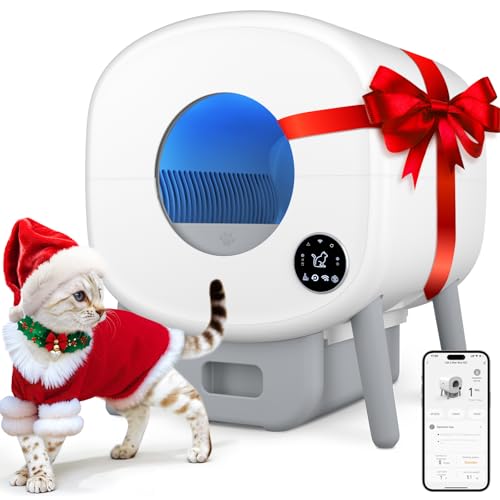
The Cumrige automatic litter box emphasizes cat safety with advanced sensors that pause cleaning when a cat is detected nearby. Its large 95-liter drum capacity accommodates multiple cats, and a 15-liter waste bin helps extend intervals between emptying, making it suitable for longer trips or households with higher litter turnover. The unit supports clump litter types and operates with quiet performance to minimize household disruption, including late-night visits. For multi-cat homes seeking reliable, hands-off maintenance, this model combines safety with substantial capacity and quiet operation.
PARUUNTYS Open Top Automatic Litter Box

The PARUUNTYS model features an open-top design for easy access and a spacious entry, which can reduce stress and encourage regular use. It includes seven safety sensors—four weight-activated and three infrared detectors—to pause automatically at the first sign of a cat’s proximity or movement. A smart app enables remote cleaning scheduling and waste disposal, with alerts when the bin is full. The system is designed to support multiple cats, though connectivity relies on a 2.4 GHz network. This option suits households prioritizing visibility, safety, and remote monitoring.
UPFAS Automatic Cat Litter Box
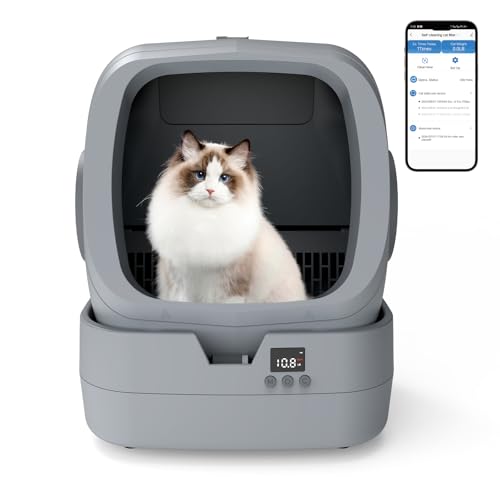
UPFAS focuses on quiet operation and app integration, aiming to minimize disruption in the home. It’s positioned for medium-sized cats and kittens, making it a versatile choice for growing households. The model supports smart control via an app, enabling remote cleaning, monitoring, and usage tracking, with real-time data on weight and visit duration. Noise is kept under 35 dB, contributing to a calm environment for both cats and owners. The combination of app control and subdued noise makes this a practical pick for sound-sensitive homes.
Mintakawa Automatic Litter Box

Mintakawa’s design targets weight monitoring and quiet performance, suitable for medium cats and kittens. With app connectivity over 2.4 GHz Wi‑Fi and Bluetooth, users can monitor weight, visit duration, and litter box usage in real time. The device emphasizes a balance between low noise and insightful data, helping owners track cat health and litter habits. Some assembly is required, but the setup supports ongoing remote management and insight-driven maintenance decisions for households seeking a data-driven approach to litter box care.
PetPivot Self Cleaning Litter Box

The PetPivot model offers an open-top design that supports larger cats and multi-cat households by providing ample space and improved airflow to reduce odors. It includes multi-layer safety protections—infrared and Hall sensors—to halt operation if a cat enters mid-cycle, and an anti-pinch mechanism to prevent injury. The 10-liter waste bin holds up to about 10 days of waste for one cat, reducing frequent bag changes. Odor-locking features and lined bags contribute to simpler maintenance and a cleaner home environment, especially for larger or more active feline families.
Buying Guide: Key Considerations For Choosing An Automatic Litter Box
- Cat size and number: Choose a model with enough drum capacity and a wide entry if you have multiple or larger cats. Open-top designs can reduce stress for some cats, but closed designs may help with odor control in smaller spaces.
- Safety features: Look for infrared or weight-based sensors that pause cleaning when a cat is present. Anti-pinch mechanisms are important for preventing injuries during automated cycles.
- Noise level: If quiet operation is a priority, check the decibel rating or user reviews mentioning sound. Ultra-quiet models are ideal for night-time use.
- App and connectivity: Apps can simplify scheduling, monitoring weight, and waste levels. Ensure compatibility with your home network (most require 2.4 GHz Wi‑Fi).
- Maintenance and waste management: Larger waste bins or multiple liners reduce frequency of changes. Consider whether the unit uses standard bags and liners you already stock.
- Litter compatibility: Most units support clumping litters; confirm compatibility if you use silica or non-traditional litters.
- Assembly and setup: Some models require assembly; evaluate the ease of setup and any ongoing maintenance steps like liner replacement or module cleaning.
- Power and connectivity reliability: A stable Wi‑Fi connection and reliable power supply contribute to consistent operation and remote alerts.
When selecting an automatic litter box, balance capacity, safety, noise, and connectivity with your household’s cat count and routine. For homes prioritizing ongoing health monitoring, weight tracking and app-based analytics add valuable context. For others, a straightforward, open-top design with robust safety sensors may be the simplest path to cleaner floors and less daily scooping.