The right aquarium air pump setup can power multiple tanks with reliable oxygenation and efficient operation. This guide highlights top pumps designed for multi-tank systems, comparing output, noise, durability, and versatility. Each product section includes a concise summary of key features to help you choose what fits your tanks best.
Summary of chosen products:
| Product | Tank Capacity | Outlets | Key Benefit |
|---|---|---|---|
| AQQA Aquarium Air Pump | Up to 200 gallons | 2 outlets | Stainless steel dual outlet for multi-tank use |
| AQUANEAT Aquarium Air Pump | Up to 200 gallons | 4 outlets | High flow with adjustable control |
| HITOP 10W Aquarium Pump | Four tanks or ponds | 4 outlets | High volume, adjustable output |
| Uniclife Dual Outlet Pump | 10–100 gallon tanks | 2 outlets | Quiet operation with adjustable flow |
| Pawfly 50 GPH Pump | Up to 60 gallons | 2 outlets | Ultra-quiet with low power |
Below are five Amazon products selected for versatility, reliability, and suitability for running multiple tanks. Each section provides a concise overview and practical considerations to help you compare at a glance.
AQQA Dual Outlet Air Pump For Tanks

AQQA offers a powerful 3W unit with a stainless steel dual outlet design, making it suitable for running two separate tanks or sections of a larger system. It provides up to 100 GPH air flow and a maximum pressure of 18 Kpa, enabling compatible operation with various air stones and accessories. The pump emphasizes energy efficiency and stable output for reliable aeration.
Noise is controlled with a sturdy, multi-layer construction and soft rubber pads at the base. The pump’s compact footprint and durable materials support use in both freshwater and seawater setups. Its dual outlets enable independent aeration configurations, which is ideal for hobbyists managing multiple tanks or zones.
AQUANEAT 300GPH Multi-Outlet Pump

This AQUANEAT model delivers a robust 300 GPH total output and includes four outlets, enabling easy distribution to multiple filters, stones, or aeration devices across several tanks. A control knob lets you adjust airflow to match tank size and bioload. The unit is designed for quiet operation with stabilizing feet to minimize vibration and movement during use.
With multiple outlets, it is particularly well-suited for hobbyists who run several small-to-medium tanks or a hydroponics setup accompanying fish tanks. Its compact dimensions make it feasible to position on shelves or inside cabinets while maintaining easy access to controls and tubing.
HITOP 10W Four-Outlet Powerhouse
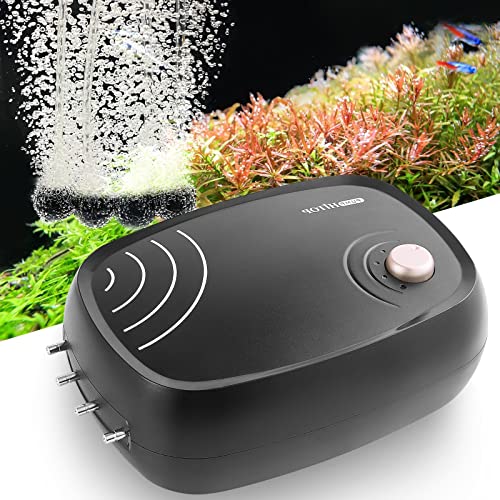
HITOP’s 10W air pump pushes a high air volume suitable for connecting to four outlets, enabling simultaneous aeration across multiple tanks, a bubbler wall, or larger ponds. Key specs include a maximum air volume of 320 GPH and a strong 22 kPa pressure. An adjustable control knob allows fine-tuning to match tank sizes, making this a versatile choice for multi-tank systems or hydroponic setups involving fish.
The unit is designed for broad application, from small home aquariums to community tanks and even outdoor ponds. Its robust build and adjustable airflow help ensure adequate oxygenation during peak stocking periods or enhanced circulation in larger installations.
Uniclife Dual Outlet Quiet Air Pump
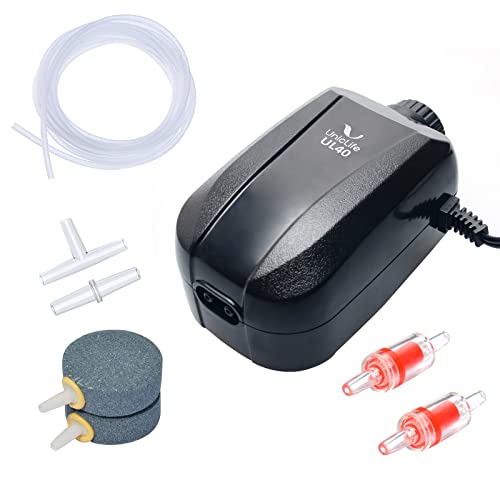
Uniclife provides a compact, low-noise solution with dual outlets and a 64 GPH flow rate. This pump is well-suited for 10–100 gallon tanks, offering adjustable airflow via a rotary knob to tailor aeration to the tank’s needs. It operates quietly—an important consideration for bedrooms or living spaces—while still delivering reliable oxygenation.
Designed for easy maintenance, it includes commonly used accessories like airline tubing and check valves. Its compact size makes it a flexible option when configuring a multi-tank setup that fits within a cabinet or stand without taking up excessive space.
Pawfly 50 GPH Quiet Multi-Tank Pump

The Pawfly model offers a steady 50 GPH output with two outlets and a notably low power draw of about 1.25 W. Its top knob allows manual adjustment of air volume, accommodating different tank sizes or oxygenation needs. Shock-absorbent feet help minimize vibration and noise, contributing to a quieter operation in shared living spaces.
With a simple design and reliable performance, this pump is a practical option for smaller multi-tank setups, especially where energy efficiency and low noise are priorities. It pairs well with airline tubing, stones, and basic filtration accessories to support multiple small aquariums or container systems.
Buying Guide: Key Considerations For Multi-Tank Setups
When selecting an aquarium air pump for multiple tanks, several factors determine the best fit. Consider the number of tanks, total water volume, and whether you need independent control for each tank or a shared aeration network.
- Outlets and airflow: More outlets allow distributing air to multiple devices across tanks. Ensure the pump can deliver sufficient total airflow (GPH or LPM) for your combined system, and check if individual outlets can be visually distinguished or individually controlled.
- Noise and vibration: Quiet operation improves living spaces. Look for rubber feet, vibration-damping housings, and double-wall construction to minimize noise.
- Durability and materials: Stainless steel or aluminum housings, copper components, and lubricant-free designs tend to offer longer lifespans and better heat dissipation in continuous operation.
- Adjustability: A dial or knob to fine-tune air volume helps match aeration to tank size, stocking level, and plant needs. This is especially helpful in mixed tank environments.
- Maintenance and accessibility: Consider ease of cleaning, availability of spare parts, and whether tubing, check valves, and stones are included or sold separately.
- Environment and placement: Ensure adequate ventilation around the pump and plan for accessible placement to prevent overheating. Grouping compatible pumps reduces space while maintaining performance.
In multi-tank installations, it can be beneficial to map air lines to specific tanks and test the balance of airflow. If tanks have different stocking densities or plant requirements, independent outlets with adjustable flow can prevent over-aeration in some tanks and under-aeration in others. For larger or more complex systems, combining high-output pumps with reliable distribution manifolds or branch tubing can streamline management while maintaining consistent oxygenation.